SOIL RESTORATION FIELD GUIDE · PRACTICAL GARDENING
Healthy Soil Needs Space to Breathe
Discover why garden soil becomes hard and dense—and how roots, organic matter, mulch, and careful gardening habits can help restore its structure.
Have you ever tried planting vegetables in a garden bed only to discover that the soil feels almost as hard as a sidewalk?
Perhaps water collects on the surface after rainfall, seedlings struggle to establish roots, or a garden fork barely penetrates the ground.
These problems may indicate soil compaction.
Compacted soil has fewer or smaller spaces between its particles, making it harder for air, water, and roots to move through the ground.
It is a common problem in home gardens, especially where people repeatedly walk on planting beds or work the soil while it is wet.
The good news is that improving compacted soil does not always require deep digging or repeated tilling.
Many gardens benefit from a combination of reduced foot traffic, organic matter, mulch, living roots, and occasional targeted loosening.
Understanding what causes compaction is the first step toward rebuilding healthier, more productive garden soil.
What Is Soil Compaction?
Healthy soil contains mineral particles, organic matter, water, air, and living organisms.
Between the solid particles are spaces called pores.
Some pores hold water, while others allow air to move through the soil.
Larger pores also help water drain and provide pathways for roots.
Compaction occurs when pressure pushes soil particles closer together and reduces pore space.
The result is often denser soil with restricted drainage and less available oxygen.
Plant roots may have difficulty growing through these dense layers.
Water can also struggle to infiltrate the surface or move downward.
However, soil density naturally varies with texture and depth.
Clay-rich soil, for example, may feel firm even when its structure is functioning reasonably well.
That is why it is important to examine several symptoms before deciding that compaction is the main problem.
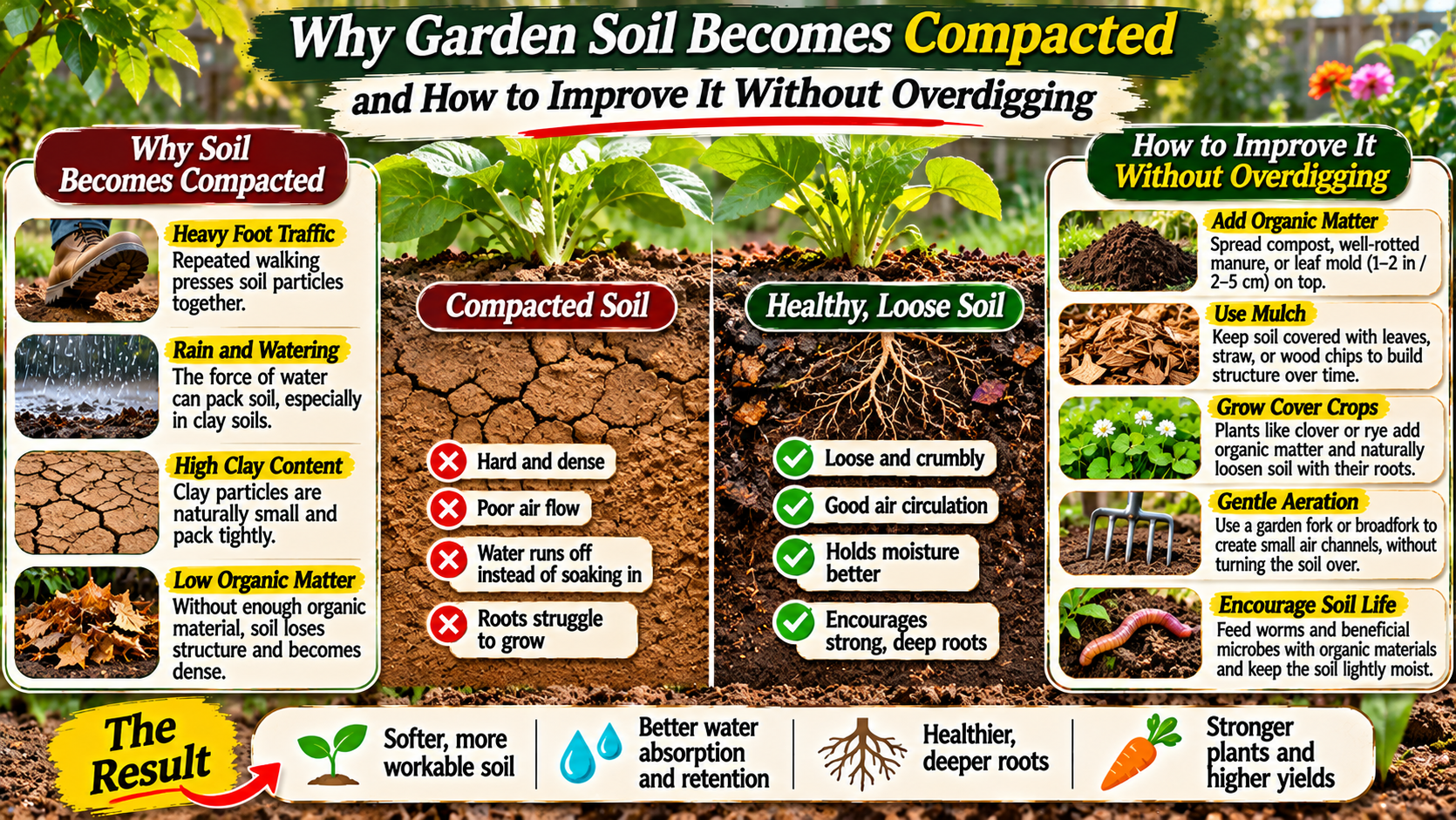
SOIL PROFILE / STRUCTURE COMPARISON
Why Garden Soil Becomes Compacted
Soil compaction usually develops through repeated pressure, unsuitable working conditions, or disturbance that weakens soil structure.
Several everyday gardening activities can contribute.
Walking on Garden Beds
Foot traffic is one of the most common causes of compaction in small gardens.
Each step applies pressure to the soil.
Repeated walking can gradually compress the upper layers, especially when the soil is moist.
Garden beds that double as pathways are particularly vulnerable.
Working Soil When It Is Too Wet
Wet soil is often more vulnerable to structural damage.
Digging, rototilling, or walking on saturated soil can compress particles and destroy existing aggregates.
As the soil dries, damaged areas may harden into dense clods.
This is especially noticeable in many clay-rich soils.
Repeated Tilling
Tilling can temporarily make the surface appear loose and fluffy.
However, frequent intensive cultivation may break apart stable soil aggregates and accelerate the loss of organic matter.
Under some conditions, repeated tilling at the same depth can also contribute to a compacted layer beneath the cultivated zone.
This is sometimes called a tillage pan.
Heavy Equipment and Wheel Traffic
Wheelbarrows, garden carts, and machinery can apply substantial pressure to the ground.
Repeated movement along the same areas may create compacted tracks.
Heavy equipment is especially problematic when soil is wet.
Low Organic Matter
Organic matter helps support soil aggregation and biological activity.
Soils with little organic material may be more vulnerable to crusting and structural decline, depending on their texture and management history.
However, adding organic matter is not an instant cure for severe deep compaction.
Its greatest benefits often develop gradually.
How to Recognize Compacted Garden Soil
Compaction can affect plant growth in several ways.
Common warning signs include slow water infiltration, shallow roots, poor seedling growth, and unusually high resistance when inserting a garden tool.
You may also notice puddles remaining after rainfall or irrigation.
However, these symptoms can have other causes.
For example, standing water may result from a high water table, naturally slow-draining subsoil, or poor landscape grading.
Yellowing plants can indicate nutrient problems, disease, or excess moisture rather than compaction alone.
For this reason, a few simple observations are more useful than relying on a single symptom.
Three Simple Ways to Check Your Soil
BACKYARD FIELD TESTS / NO SPECIAL EQUIPMENT REQUIRED
Test 1: The Garden Fork Check
When soil is moist but not saturated, gently push a garden fork into the ground. Notice whether resistance increases sharply at a particular depth. Avoid testing extremely dry soil, which can feel hard even without unusual compaction.
Test 2: Examine Root Growth
Inspect the roots of a mature plant when removing it at the end of the season. Roots that abruptly turn sideways or remain concentrated above a dense layer may indicate restricted growth.
Test 3: Observe Water Infiltration
Watch how water enters the soil during gentle irrigation. Persistent surface pooling may suggest restricted infiltration, although soil texture and moisture conditions also affect the result.
For a more complete assessment, local university extension services or soil laboratories may offer useful guidance.
Standard nutrient soil tests are valuable for fertility management, but they do not necessarily measure physical compaction.
1. Stop Walking on Planting Beds
One of the most effective ways to prevent further compaction is also one of the simplest.
Keep regular foot traffic out of growing areas.
Designate permanent paths between garden beds.
For vegetable gardens, consider beds narrow enough to reach from either side without stepping onto the planting surface.
A width of approximately three to four feet often works well, depending on the gardener’s reach and available space.
Paths can be covered with wood chips or another suitable material.
Permanent pathways concentrate foot traffic in areas where soil compaction is less likely to interfere with crop roots.
PRACTICAL GARDEN DESIGN TIP
Create Permanent Beds and Permanent Paths.
Reducing repeated pressure on growing soil is often more sustainable than loosening the same compacted area every season.
2. Add Compost to Support Better Soil Structure
Finished compost is a valuable amendment for many garden soils.
It contributes organic matter and supports the biological processes involved in soil aggregation.
Stable aggregates help create a structure with pores of different sizes.
These pores influence water storage, drainage, aeration, and root growth.
Compost can be applied to the soil surface and gradually incorporated through biological activity and normal gardening operations.
In a new bed, shallow incorporation may sometimes be appropriate, especially where soil conditions are poor.
However, repeated deep digging is not required to obtain many of compost’s benefits.
How Much Compost Should You Add?
The appropriate amount depends on soil conditions, existing organic matter, and the compost’s nutrient content.
For established beds, a relatively thin surface layer of finished compost is often sufficient for routine maintenance.
A layer around half an inch to one inch can be a reasonable starting point for many gardens, but local recommendations should take priority.
Avoid excessive applications, especially of nutrient-rich manure-based compost.
Too much compost can contribute to nutrient imbalances and phosphorus accumulation.
Use mature, properly processed compost rather than fresh manure around edible crops.
3. Protect the Surface with Organic Mulch
Mulch covers exposed soil and helps protect it from direct rainfall and temperature extremes.
Raindrops striking bare ground can break apart surface aggregates.
Fine particles may then form a crust that slows water infiltration.
Organic mulch reduces this impact.
It can also moderate moisture fluctuations and provide habitat for soil organisms.
Common options include shredded leaves, straw, and untreated wood chips.
Different materials are appropriate for different garden settings.
For example, straw and shredded leaves are often convenient around vegetable crops.
Wood chips are widely used around trees, shrubs, and garden pathways.
Keep mulch away from direct contact with plant stems and tree trunks to reduce moisture-related problems.
4. Use Living Roots to Improve Soil Over Time
Plants do more than grow above the ground.
Their roots interact with soil particles, microorganisms, and pore spaces.
As roots grow, they can explore existing openings and influence soil structure.
When roots die and decompose, some channels may remain available for water movement and later root growth.
Root activity also supports soil organisms through the release of organic compounds.
This is one reason cover crops can be useful in soil restoration.
Cover Crops for Garden Beds
Cover crops are plants grown primarily to protect and improve soil rather than for immediate harvest.
Examples include cereal rye, oats, clover, and certain brassicas.
The best choice depends on climate, season, garden size, and the following crop.
Cover crops can reduce bare-soil exposure, contribute organic matter, and support biological activity.
Some species develop substantial root systems, but they should not be expected to break through every severely compacted layer.
Successful use also requires a plan for terminating the cover crop before planting vegetables.
5. Try a Broadfork Instead of Repeated Deep Digging
Sometimes soil is too dense for roots to establish easily, especially in a new garden built on previously disturbed or heavily trafficked ground.
In these cases, limited mechanical loosening may help.
A broadfork is a manual gardening tool with several long tines and two handles.
It is designed to loosen soil by lifting and gently fracturing it rather than completely turning it over.
This can preserve more of the existing soil layering than conventional deep digging.
However, broadforking is not appropriate for every soil condition.
It should generally be avoided when the soil is saturated.
It may also be ineffective in extremely rocky ground or where compacted material is too dense for safe manual use.
Broadforking can relieve some physical restrictions, but preventing renewed compaction is essential.
6. Consider No-Dig Gardening
No-dig gardening is a management approach that minimizes routine soil disturbance.
Instead of repeatedly turning the soil, gardeners often apply organic matter at the surface and maintain permanent growing beds.
Mulch and compost help protect the soil while plant roots and organisms contribute to gradual structural development.
This approach can reduce disturbance to soil aggregates and biological habitats.
It also avoids repeatedly exposing buried weed seeds through cultivation.
However, no-dig gardening is not a universal solution to every soil problem.
A severely compacted subsoil layer, drainage obstruction, or construction-related damage may require targeted intervention.
In such cases, correcting the underlying problem before establishing a low-disturbance system may be more effective.
GARDEN RESTORATION / PRACTICAL ACTION PLAN
Check soil moisture, root growth, drainage, and the depth of any resistant layer.
Keep feet, carts, and heavy equipment away from planting beds.
Apply suitable mulch and use compost based on soil needs.
Grow appropriate crops or cover crops to support soil biological activity.
Observe water infiltration and root development over subsequent growing seasons.
Does Adding Sand Help Compacted Clay Soil?
Adding a small amount of sand to clay-rich garden soil is usually not a reliable solution.
Clay and sand behave differently, and poorly chosen mixtures can remain dense or become difficult to manage.
Meaningful changes to soil texture generally require substantial quantities of mineral material.
For most home gardeners, improving organic matter management, preventing traffic, and protecting the surface are more practical starting points.
It is also important to distinguish compaction from naturally slow drainage.
Some clay soils drain slowly because of their texture and landscape position, even without severe compaction.
If drainage is persistently poor, raised beds or changes to garden layout may be more effective than attempting to change the entire soil profile.
How Long Does It Take to Improve Compacted Soil?
There is no single timeline for soil restoration.
Surface conditions may improve relatively quickly when traffic stops and the soil is protected.
Biological improvements often take longer.
Roots, earthworms, fungi, and other organisms gradually influence soil structure as organic matter cycles through the system.
Severe compaction below the surface may persist for years if it is not adequately addressed.
Progress depends on soil texture, climate, moisture, biological activity, and the depth of the compacted layer.
Rather than expecting an immediate transformation, monitor practical indicators such as root penetration, infiltration, and plant performance.
Compacted Soil Improvement Methods Compared
| Method | Main Benefit | Important Limitation |
|---|---|---|
| Permanent pathways | Prevents repeated pressure on beds | Does not instantly repair existing deep compaction |
| Finished compost | Supports organic matter and aggregation | Excess applications can cause nutrient buildup |
| Organic mulch | Protects the surface and moderates moisture | Limited immediate effect on deep layers |
| Cover crops | Provides living roots and surface protection | Requires seasonal planning and management |
| Broadforking | Can loosen some compacted layers | Temporary if traffic and wet-soil damage continue |
| No-dig management | Reduces routine soil disturbance | May not resolve severe pre-existing restrictions alone |
Common Mistakes to Avoid
One mistake is digging wet soil in an attempt to improve drainage.
This can make structural problems worse.
Another mistake is repeatedly rototilling the same garden bed without addressing the cause of compaction.
Temporary looseness does not necessarily translate into lasting improvement.
Some gardeners also add excessive amounts of compost, assuming more organic matter is always better.
In reality, nutrient balance matters.
Another common problem is walking across newly loosened beds.
This can quickly undo some of the benefits of soil improvement.
Finally, avoid treating every drainage problem as compaction.
Landscape grading, soil horizons, and groundwater conditions can also affect water movement.
Frequently Asked Questions
What causes garden soil to become compacted?
Common causes include repeated foot traffic, heavy equipment, working wet soil, and soil management practices that damage structure.
Can compacted soil improve without digging?
Yes. Mild or surface compaction may improve through reduced traffic, organic matter management, mulch, and living roots. Severe deep compaction may need targeted loosening.
Does compost loosen compacted soil?
Compost can support soil aggregation and biological activity over time, but it is not an immediate remedy for every compacted layer.
Is tilling good for compacted soil?
Tilling can temporarily loosen soil, but frequent or poorly timed tilling may damage structure and contribute to renewed compaction.
Can earthworms help compacted soil?
Earthworm activity can create channels and influence soil structure, although results depend on soil conditions and the organisms present.
Should I add sand to compacted clay soil?
Small sand additions are generally not a dependable solution. Improving soil management is often more practical for home gardens.
How long does soil restoration take?
It varies. Some surface improvements can occur relatively quickly, while deeper structural recovery may require multiple growing seasons or targeted intervention.
Final Thoughts
Compacted garden soil can limit root growth, reduce water infiltration, and make gardening more difficult.
However, the solution does not always involve repeated deep digging.
Preventing unnecessary pressure is often the most important first step.
Permanent pathways, suitable compost applications, organic mulch, and living roots can help protect and gradually improve soil structure.
Where compaction is severe, carefully timed mechanical loosening may provide additional benefits.
The goal is not simply to make soil feel soft for a few days.
It is to develop a stable structure that supports healthy roots, soil organisms, air exchange, and water movement over time.
With consistent management, many garden beds can become easier to work and more supportive of productive plants.
Healthy soil is built through thoughtful habits, not constant disturbance.