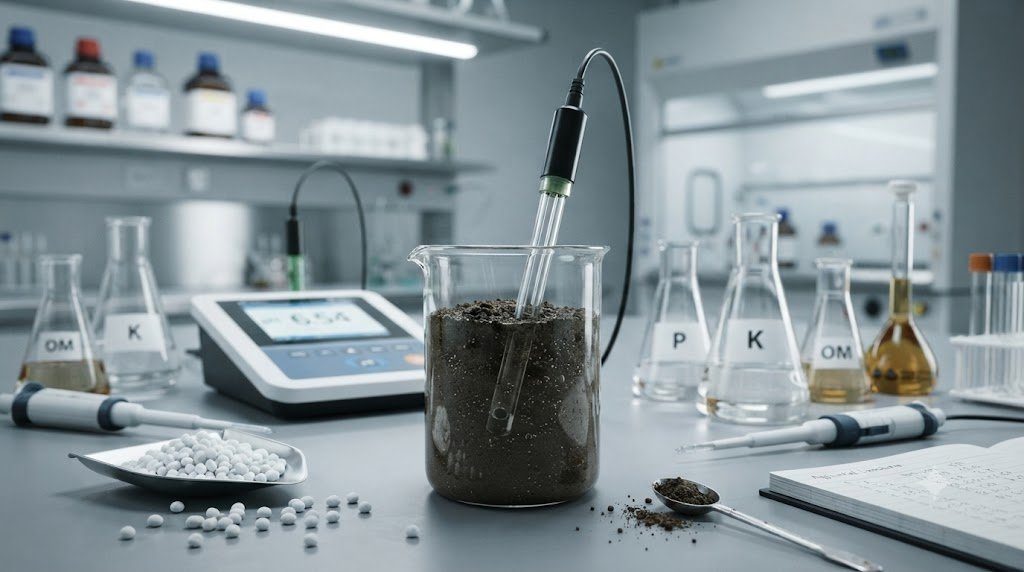
GARDEN SOIL LAB / PRACTICAL GROWING GUIDE
Turn Your Soil Test Results into a Better Garden
A practical guide to understanding soil acidity, nutrient ratings, organic matter, and fertilizer recommendations without getting lost in laboratory terminology.
A garden soil test report can look confusing when you open it for the first time.
It may contain unfamiliar abbreviations, numbers measured in parts per million, colored nutrient bars, and recommendations for materials you have never used.
However, the purpose of a soil test is simple: to help you understand your soil and make better growing decisions.
A laboratory report can show whether your soil is acidic or alkaline, whether certain nutrients are likely to limit plant growth, and whether fertilizer or lime is recommended.
It can also help prevent unnecessary spending on garden products.
The most important rule is to read the laboratory’s interpretation and recommendations alongside the numbers—not to judge nutrient values in isolation.
Different laboratories use different testing methods, so the same numerical result may not have the same meaning everywhere.
1. Start with the Sample Information
Before examining nutrient levels, check the information at the top of the report.
Most laboratories identify the sample, testing date, requested analysis, and intended crop or garden use.
Confirm that the sample belongs to the correct garden bed.
A vegetable plot, lawn, and ornamental border may have different nutrient requirements, even when their soil test results are similar.
The crop information matters because laboratories often calculate recommendations according to what you plan to grow.
Also check the sampling depth and units used in the report.
These details influence how results should be interpreted.
FIRST CHECK / REPORT HEADER
Verify the sample location, collection date, crop type, laboratory method, and measurement units before making any fertilizer decisions.
2. Understand Soil pH
Soil pH measures acidity or alkalinity.
The pH scale runs from 0 to 14, with 7 considered neutral.
Values below 7 are acidic, while values above 7 are alkaline.
Soil pH affects how easily plants can access nutrients already present in the soil.
For many common garden vegetables, slightly acidic to near-neutral soil is suitable.
However, the ideal pH depends on the plant.
Blueberries, for example, prefer substantially more acidic conditions than many vegetables.
Some ornamental plants tolerate or prefer alkaline soils.
SOIL CHEMISTRY / pH REFERENCE
Below 7
Acidic
7.0
Neutral
Above 7
Alkaline
These are chemical classifications, not universal gardening targets.
What if the Soil Is Too Acidic?
If the pH is below the preferred range for your plants, the laboratory may recommend agricultural lime.
Lime raises soil pH by reducing acidity.
Do not guess the amount from pH alone. The required quantity also depends on soil buffering capacity and other properties.
What if the Soil Is Too Alkaline?
High-pH soils can limit the availability of iron, manganese, and some other nutrients.
Acidifying amendments may be appropriate in certain situations, but changing alkaline soil can be difficult, particularly when free lime is present.
Sometimes selecting plants suited to existing conditions is the more practical option.
3. Read the Nitrogen, Phosphorus, and Potassium Results
Nitrogen, phosphorus, and potassium are three major nutrients needed for plant growth.
They are commonly abbreviated as N, P, and K.
However, soil laboratories do not always test or report all three in the same way.
Nitrogen (N)
Nitrogen supports leaf development, photosynthesis, and many essential plant processes.
Unlike phosphorus and potassium, available nitrogen can change quickly because of plant uptake, microbial activity, rainfall, and leaching.
For this reason, many routine garden soil tests do not provide a reliable long-term nitrogen rating.
Instead, laboratories may recommend nitrogen based on the crop and regional research.
Phosphorus (P)
Phosphorus is important for energy transfer, root development, and plant reproduction.
A soil report may describe phosphorus as low, adequate, high, or excessive.
If phosphorus is already sufficient, adding more may provide little benefit.
Excess phosphorus can also contribute to water pollution when soil particles or dissolved nutrients reach waterways.
Potassium (K)
Potassium helps regulate water movement, enzyme activity, and plant stress responses.
Low potassium may justify a fertilizer application.
High potassium levels generally mean additional potassium is unnecessary for the tested crop.
Always follow the laboratory’s crop-specific interpretation.
4. What Do Low, Medium, and High Nutrient Ratings Mean?
Many reports include colored bars or categories showing whether nutrient levels are below, within, or above the desired range.
These categories are usually based on research linking soil test results with plant responses to fertilizer.
A low rating means the crop is more likely to benefit from additional nutrients.
An optimum rating generally means the nutrient supply is adequate for the intended use.
A high rating means more fertilizer is unlikely to improve growth.
Importantly, higher is not always better.
Adding unnecessary nutrients wastes money and may create environmental problems.
| Report Rating | General Meaning | Likely Response |
|---|---|---|
| Low | Below the desired range | Nutrient application may help |
| Medium | Intermediate level | Follow crop-specific guidance |
| Optimum | Generally sufficient | Little or no additional supply may be needed |
| High / Excessive | Above the target range | Avoid unnecessary additions |
5. Understand the Measurement Units
Laboratories may report nutrient concentrations in parts per million, abbreviated ppm.
For soil concentrations by mass, 1 ppm is equivalent to 1 milligram per kilogram.
Some laboratories use pounds per acre, kilograms per hectare, or other reporting units.
Fertilizer recommendations may instead be expressed as pounds per 1,000 square feet or grams per square meter.
These measurements serve different purposes.
A nutrient concentration describes the tested soil sample. An application rate tells you how much material to add to a specified area.
Do not treat a ppm result as though it were a fertilizer application instruction.
Also avoid comparing results from different laboratories without checking their extraction methods and rating systems.
6. Organic Matter and Soil Health
Some soil tests include organic matter as a percentage.
Organic matter consists of decomposed plant and animal materials and other carbon-containing substances in the soil.
It contributes to nutrient cycling, soil structure, and water retention.
However, there is no single ideal organic matter percentage for every garden.
Natural soil type, climate, drainage, and management history influence the expected range.
If organic matter is low, the report may support gradually incorporating suitable finished compost or maintaining organic mulches.
These practices should complement, rather than replace, decisions based on measured nutrient levels.
Compost can contain substantial phosphorus and potassium, so adding large quantities every year is not always appropriate.
7. Calcium, Magnesium, and Micronutrients
More detailed reports may include calcium, magnesium, sulfur, iron, zinc, manganese, boron, and other nutrients.
Plants require these elements in different quantities.
Calcium supports cell-wall structure, while magnesium is a central component of chlorophyll.
Micronutrients are needed in smaller amounts but remain essential for healthy growth.
Deficiency symptoms can sometimes resemble problems caused by poor drainage, root damage, or unsuitable pH.
For that reason, a yellow leaf does not automatically mean a fertilizer deficiency.
Use the report’s interpretations before applying micronutrient products.
Excessive applications of some micronutrients can damage plants.
8. What Does Cation Exchange Capacity Mean?
Some reports include cation exchange capacity, usually abbreviated CEC.
CEC describes the soil’s capacity to hold positively charged ions, including potassium, calcium, and magnesium.
Clay minerals and organic matter contribute to this capacity.
Many sandy soils have relatively low CEC, while soils with more clay or organic matter may have higher values.
CEC helps explain why some soils retain certain nutrients more effectively than others.
It is not a direct score of overall soil quality.
A soil with high CEC can still have drainage or compaction problems.
Similarly, a sandy soil with low CEC can support productive gardening when managed appropriately.
9. How to Read Fertilizer Recommendations
The recommendation section is often the most useful part of the entire report.
It translates laboratory measurements into practical guidance for the crop you selected.
Recommendations may specify nitrogen, phosphate, potash, lime, or other amendments.
Fertilizer labels commonly use three numbers representing percentages by weight of nitrogen, available phosphate expressed as P₂O₅, and soluble potash expressed as K₂O.
For example, a fertilizer labeled 10-5-5 contains 10% nitrogen, 5% available phosphate, and 5% soluble potash by weight.
These label conventions differ from simply listing elemental nutrient concentrations.
Always check whether the laboratory recommendation refers to nutrients or to the weight of a particular fertilizer product.
FERTILIZER LABEL / SIMPLE EXAMPLE
10–5–5
This fertilizer contains 10% nitrogen, 5% available phosphate (P₂O₅), and 5% soluble potash (K₂O) by weight. It is an example of label interpretation, not a recommendation for every garden.
10. A Sample Soil Report Explained
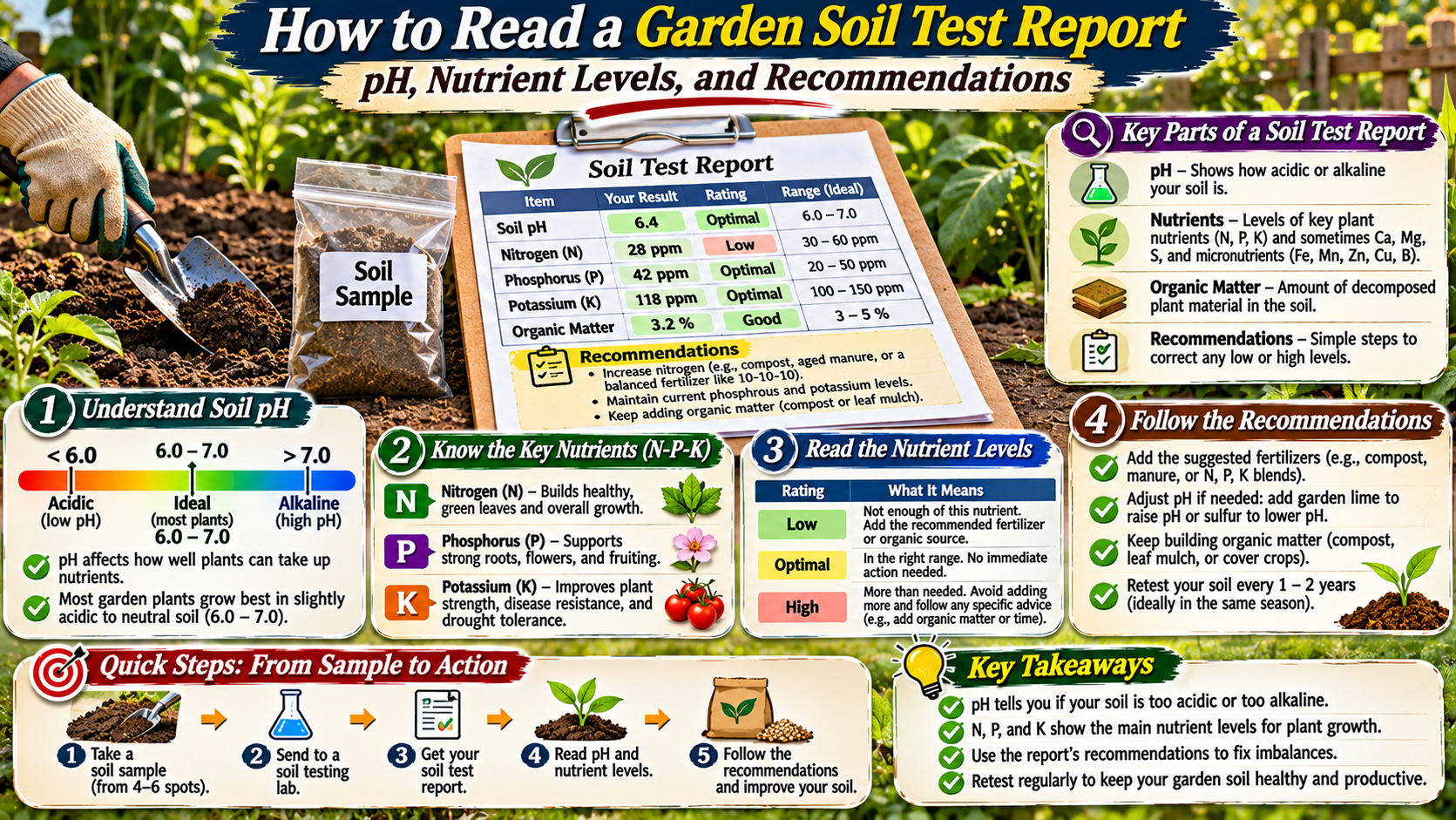
Imagine receiving the following simplified laboratory report for a vegetable garden.
The values below are fictional and intended only to demonstrate how to read the categories.
| Test Item | Example Result | Interpretation |
|---|---|---|
| Soil pH | 6.4 | Suitable for many vegetables |
| Phosphorus | High | Additional phosphorus likely unnecessary |
| Potassium | Low | Follow the laboratory’s potassium recommendation |
| Organic Matter | 2.1% | Evaluate against local soil conditions |
In this example, the gardener should not automatically apply a balanced fertilizer containing substantial phosphorus.
Instead, the report suggests paying attention to potassium while avoiding unnecessary phosphorus additions.
The pH is already suitable for many common vegetables, so lime may not be required.
The exact fertilizer amount must come from the laboratory’s recommendations and the size of the garden.
11. Convert Recommendations to Your Garden Size
Laboratories often provide fertilizer recommendations for a standard area.
In the United States, that might be 1,000 square feet.
In the United Kingdom, recommendations may use square meters.
Suppose a report recommends 2 pounds of a particular fertilizer product per 1,000 square feet.
For a 200-square-foot garden, the proportional amount would be 0.4 pounds of that same product.
This calculation assumes the recommendation is expressed as product weight, not nutrient weight.
Always verify the units, product analysis, application timing, and maximum safe rate before applying fertilizer.
12. Common Soil Test Mistakes to Avoid
FIELD CHECKLIST / AVOID THESE ERRORS
Comparing numbers from different labs: Test methods and interpretation ranges may differ.
Adding fertilizer to already-high nutrients: More fertilizer does not always produce better growth.
Changing pH without a recommendation: Lime and acidifying products should be selected according to soil conditions and plant needs.
Ignoring garden area: Application rates must be adjusted to the size of the planting space.
Testing immediately after amendments: Recent fertilizer, lime, or compost applications may affect results.
Assuming soil tests diagnose every problem: Compaction, disease, poor drainage, and watering problems may require separate investigation.
13. When Should You Test Garden Soil Again?
Retesting frequency depends on soil conditions, crop intensity, and the changes you are trying to monitor.
For established gardens with relatively stable fertility, testing every few years may be sufficient.
New garden beds, unusual plant symptoms, or major soil amendments may justify more frequent testing.
Use the same laboratory and similar sampling procedures when possible.
This makes results easier to compare over time.
Testing during a consistent season can also help reduce unnecessary variation.
Keep copies of previous reports to track changes in pH, nutrient levels, and organic matter.
Frequently Asked Questions
What is the most important number on a soil test report?
Soil pH is an important starting point, but nutrient ratings and crop-specific recommendations are equally important for deciding what action to take.
What does a high phosphorus result mean?
It usually means the tested soil already contains sufficient phosphorus for the intended crop, so additional phosphorus fertilizer may be unnecessary.
Why is nitrogen missing from my soil test?
Available nitrogen changes rapidly in many soils. Some laboratories therefore base nitrogen recommendations on crop requirements rather than a routine nitrogen measurement.
Is a soil pH of 7 good for vegetables?
Many vegetables can grow well near neutral pH, but the ideal range depends on the crop and local soil conditions.
Should I add compost if my nutrient levels are already high?
Not automatically. Compost contributes nutrients as well as organic matter, so repeated applications can increase phosphorus and other nutrient levels.
Can a soil test identify poor drainage?
Routine fertility tests generally do not diagnose drainage problems directly. Soil structure, infiltration, and site conditions may need separate assessment.
Final Thoughts
A garden soil test report is most valuable when its numbers are translated into practical decisions.
Start by confirming the sample information and intended crop.
Next, examine soil pH and the laboratory’s nutrient ratings.
Pay particular attention to nutrients identified as low, optimum, or excessive.
Then read the fertilizer and lime recommendations carefully, checking the units and application rates.
Remember that a soil test is a guide to soil chemistry, not a complete diagnosis of every gardening problem.
Healthy plant growth also depends on water, sunlight, soil structure, drainage, and suitable growing conditions.
By using soil test results thoughtfully, gardeners can avoid unnecessary amendments, manage nutrients more efficiently, and create better conditions for long-term plant growth.