THE SOIL & GARDEN FIELDBOOK · SOIL HEALTH SERIES
Two Garden Helpers, Two Different Jobs
Understand how compost improves soil conditions, how fertilizers supply plant nutrients, and when your garden may benefit from one, the other, or both.
Healthy plants begin with healthy soil, but gardeners often face an important question when preparing a growing area: should they add compost or fertilizer?
Both products can support plant growth, yet they work in different ways.
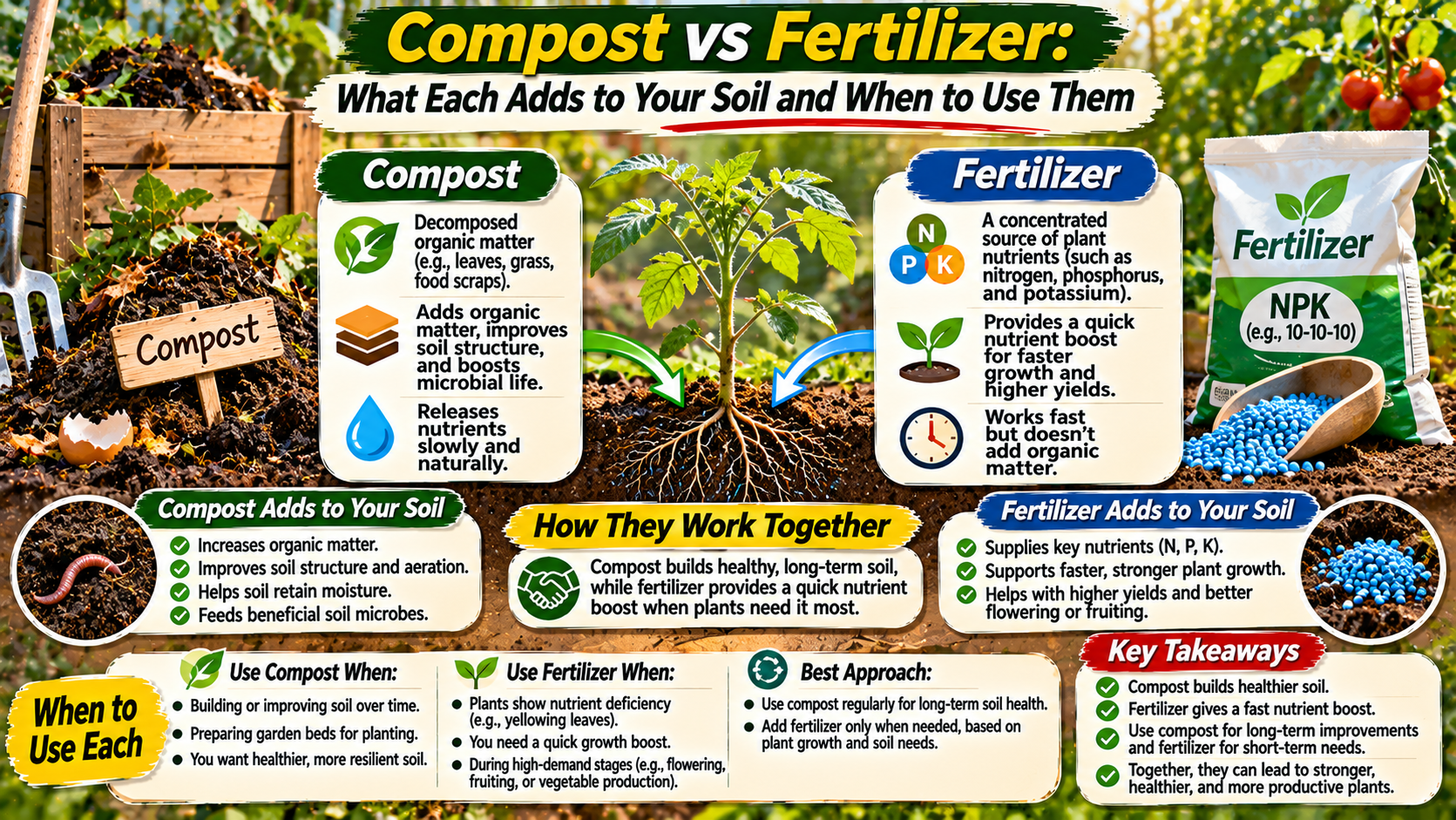
Compost is mainly used to improve soil conditions by adding decomposed organic matter. Fertilizer is primarily used to supply specific nutrients that plants need.
The difference matters because poor plant growth does not always mean the soil needs more fertilizer. Sometimes the real problem is compaction, inadequate drainage, low organic matter, or unsuitable soil moisture.
Likewise, adding compost does not guarantee that a hungry crop will receive enough nutrients at the right time.
Compost helps improve the growing environment, while fertilizer helps address plant nutrient requirements.
Understanding what each product contributes makes it easier to build productive vegetable beds, maintain lawns, and care for garden plants without wasting materials.
What Is Compost?
Compost is organic material that has undergone controlled decomposition.
It is commonly produced from materials such as leaves, grass clippings, vegetable scraps, and other suitable plant-based waste.
Microorganisms break down these materials over time, creating a dark, crumbly substance that can be incorporated into soil or used as a surface amendment.
Finished compost generally has an earthy smell and no longer resembles most of its original ingredients.
Its main gardening value comes from its organic matter.
Organic matter can improve soil structure, support soil organisms, and influence how soil stores and moves water.
Compost also contains plant nutrients, but their concentrations and availability vary considerably depending on the materials and composting process.
For this reason, compost should not automatically be treated as a complete replacement for fertilizer.
What Is Fertilizer?
Fertilizer is a material used to supply one or more nutrients needed for plant growth.
These nutrients may include nitrogen, phosphorus, potassium, and other essential elements.
Fertilizers are available in different forms, including granular products, liquids, slow-release formulations, and materials derived from organic sources.
Some fertilizers contain several major nutrients, while others provide only one or two.
Their purpose is to correct or prevent nutrient shortages.
For example, nitrogen supports leafy growth and is a major component of proteins and chlorophyll.
Phosphorus plays important roles in energy transfer and plant development.
Potassium contributes to water regulation and several essential plant processes.
However, adding more nutrients than plants need can create problems rather than improve growth.
Excess fertilizer may damage roots, contribute to nutrient runoff, or create nutrient imbalances.
THE GARDENER’S FIELD NOTE
Compost Is Not Simply a Weak Fertilizer.
Its ability to improve soil structure and organic matter makes compost valuable even when it supplies relatively small amounts of immediately available nutrients.
Compost vs Fertilizer: The Main Differences
| Feature | Compost | Fertilizer |
|---|---|---|
| Main purpose | Improve soil conditions | Supply plant nutrients |
| Organic matter | Usually substantial | Varies; often little or none |
| Nutrient content | Variable and often modest | Usually stated on the label |
| Nutrient release | Generally gradual and variable | Can be rapid or controlled-release |
| Best use | Building and maintaining soil quality | Addressing nutrient requirements |
| Main caution | Quality, salts, maturity, and overapplication | Overfertilization and nutrient losses |
How Compost Improves Soil Structure
One of compost’s greatest benefits is its influence on soil structure.
In clay-rich soils, organic matter can help improve aggregation, making the soil less dense and easier for roots to explore.
Better structure may also support drainage and air movement.
In sandy soils, compost can increase the soil’s capacity to hold water and retain some nutrients.
These effects are not identical in every garden.
Soil texture, existing organic matter, compost quality, and management practices all influence the results.
Repeated moderate applications may be more useful than adding an excessive amount at once.
Compost also supplies energy and habitat for many soil organisms involved in organic matter decomposition and nutrient cycling.
Understanding NPK on Fertilizer Labels
Many fertilizer packages display three numbers, such as 10-10-10 or 5-10-5.
These numbers represent the product’s guaranteed percentages of nitrogen, available phosphate, and soluble potash, respectively, under the common US labeling system.
The labels are often summarized as N-P-K.
The first number refers to nitrogen.
The second represents available phosphate, expressed as P₂O₅.
The third represents soluble potash, expressed as K₂O.
A 10-10-10 fertilizer therefore contains 10% nitrogen, 10% available phosphate, and 10% soluble potash by weight.
These numbers do not describe the fertilizer’s organic matter content.
They also do not indicate that every plant needs equal amounts of all three nutrients.
A soil test and crop-specific guidance can help determine which nutrients, if any, should be added.
Does Compost Contain Plant Nutrients?
Yes. Compost contains nutrients, including nitrogen, phosphorus, potassium, and smaller amounts of other elements.
However, not all these nutrients are immediately available to plants.
Some are held within organic compounds and become available as microorganisms continue decomposing the material.
This process is called mineralization.
The rate of nutrient release depends on temperature, moisture, compost composition, and soil biological activity.
Compost made from different feedstocks can have very different nutrient concentrations.
For example, compost containing substantial amounts of manure may be richer in certain nutrients than compost made mainly from leaves.
That variation is why applying compost based only on its appearance can be misleading.
Where available, a compost analysis can provide useful information about nutrient content, maturity, and soluble salts.
When Should You Add Compost?
Compost is often added when preparing new garden beds or improving existing soil.
For vegetable gardens, mature compost can be incorporated into the upper soil layer before planting.
In established beds, it may be applied as a surface layer and allowed to integrate gradually.
Spring and autumn are common application periods in temperate climates.
However, the appropriate timing depends on local growing seasons and soil conditions.
Avoid working soil when it is excessively wet because this can contribute to compaction.
Use only finished, suitable compost near actively growing plants.
Immature compost can continue decomposing rapidly and may temporarily affect nitrogen availability or plant growth.
Application rates should reflect the soil’s condition and the compost’s composition rather than a universal rule for every garden.
When Should You Apply Fertilizer?
Fertilizer is most useful when plants need nutrients that the soil cannot supply in sufficient quantities.
Timing should match the crop’s growth pattern and nutrient demand.
For example, some vegetable crops require additional nitrogen during periods of active growth.
Other plants may need little supplemental fertilizer if the soil already contains adequate nutrients.
Applying fertilizer before heavy rain can increase the risk of nutrient movement into nearby waterways.
Excessive applications can also cause salt injury or unbalanced growth.
For these reasons, gardeners should follow product instructions and locally appropriate recommendations.
A soil test is particularly valuable before adding phosphorus or potassium because these nutrients may already be present in sufficient amounts.
GARDEN DECISION GUIDE / WHICH ONE DO YOU NEED?
Consider mature compost and appropriate soil-management practices.
Choose a fertilizer that supplies the needed nutrient at the recommended rate.
Use suitable compost to improve soil where needed, then fertilize according to test results and crop requirements.
Check watering, drainage, light, roots, pests, and soil conditions before adding nutrients.
Using Compost and Fertilizer Together
Compost and fertilizer are not competing products.
They can complement each other when used appropriately.
Compost helps maintain soil organic matter and improve physical conditions.
Fertilizer can supply additional nutrients when crop demand exceeds what the soil and compost provide.
For example, a vegetable bed may benefit from a moderate application of mature compost before planting.
If soil testing indicates a nitrogen requirement, a suitable nitrogen fertilizer may then be used according to the crop’s needs.
However, nutrients supplied by compost should be considered when planning fertilizer applications.
Adding both without accounting for their nutrient contributions can lead to excessive phosphorus or other nutrient accumulation.
The best combination depends on the soil, crop, and materials being used.
Compost vs Fertilizer for Vegetable Gardens
Vegetable gardens often benefit from careful management of both soil structure and plant nutrition.
Compost can improve the root environment, especially in beds with low organic matter.
Fertilizer may be useful for crops with relatively high nutrient requirements.
Leafy vegetables often have substantial nitrogen needs during active growth.
Fruit-producing crops such as tomatoes also require balanced nutrition throughout development.
However, excessive nitrogen can encourage lush foliage at the expense of other aspects of plant performance.
Gardeners should avoid assuming that every vegetable crop needs the same fertilizer formulation.
Soil testing, crop-specific guidance, and observation provide a more reliable basis for decisions.
What About Raised Beds and Container Gardens?
Raised beds and containers have different management requirements.
Raised beds may contain a mixture of mineral soil, compost, and other suitable materials.
Compost can be useful, but excessive amounts may cause nutrient or salt accumulation.
Containers usually require a growing medium designed to provide adequate drainage and aeration.
Pure compost is generally not an ideal substitute for a properly formulated container mix.
Container plants may also need regular nutrient supplementation because the growing volume is limited and nutrients can be lost through drainage.
Controlled-release or appropriately diluted liquid fertilizers are commonly used, depending on the crop and growing medium.
Always follow the product’s directions and avoid applying fertilizer to severely dry or stressed roots without considering the manufacturer’s guidance.
Compost vs Fertilizer for Lawns
Lawns also respond differently to compost and fertilizer.
A thin layer of suitable, screened compost may be used as topdressing to improve soil conditions over time.
However, compost should not be applied so thickly that it smothers the grass.
Fertilizer provides nutrients needed for turf growth when soil supplies are insufficient.
The appropriate fertilizer schedule depends on the grass species, climate, soil conditions, and maintenance goals.
Cool-season and warm-season grasses have different growth patterns.
Fertilizing at the wrong time or applying too much nitrogen can increase stress or environmental losses.
Local turfgrass guidance is preferable to following a single schedule for every lawn.
Organic Fertilizer vs Compost: Are They the Same?
Organic fertilizer and compost are related but not identical.
Organic fertilizers are derived from materials such as plant residues, animal by-products, or other organic sources.
They are primarily used for their nutrient content.
Compost is primarily valued as a soil amendment, although it also supplies nutrients.
Some organic fertilizers release nutrients gradually as microorganisms break down their components.
However, the release rate varies by product and environmental conditions.
The word “organic” does not automatically mean a product is harmless or appropriate at any application rate.
Both organic and mineral fertilizers can cause problems if used excessively.
Choosing a product should depend on plant needs, soil conditions, and reliable label information.
Common Mistakes to Avoid
One common mistake is using fertilizer to solve problems caused by poor drainage or compacted soil.
Another is assuming that adding large amounts of compost will always improve soil.
Excess compost can contribute to elevated nutrient levels or soluble salts, particularly when it contains manure-rich materials.
Gardeners may also overlook the importance of compost maturity.
Unfinished compost can behave differently from stable, mature compost.
Applying fertilizer without understanding existing soil nutrient levels is another frequent problem.
It can waste money and increase the risk of environmental pollution.
Finally, adding nutrients based only on yellow leaves or slow growth can be misleading.
Water stress, unsuitable pH, pests, disease, and root damage may produce similar symptoms.
Diagnosis should come before treatment.
Why Soil Testing Is Worth the Effort
A soil test helps gardeners make informed decisions about fertilizer use.
Depending on the laboratory and test package, results may include soil pH and concentrations of selected plant nutrients.
Some tests also provide information about organic matter.
Recommendations are often tailored to particular crops or growing situations.
In the United States, university cooperative extension services commonly provide guidance on soil testing and interpreting results.
In the United Kingdom, soil-testing services and horticultural advisory resources can help gardeners understand nutrient and pH conditions.
Testing is especially useful before establishing a new garden, correcting persistent growth problems, or making substantial fertilizer applications.
It helps replace guesswork with evidence.
Frequently Asked Questions
Is compost better than fertilizer?
Neither is universally better. Compost mainly improves soil conditions, while fertilizer supplies nutrients. The right choice depends on what your soil and plants need.
Can compost replace fertilizer?
Sometimes compost and existing soil nutrients can meet a crop’s needs, but this is not guaranteed. Nutrient availability varies with compost composition and soil conditions.
Can I use compost and fertilizer together?
Yes. They can complement each other, but the nutrients supplied by compost should be considered when determining fertilizer rates.
When is the best time to add compost?
Before planting or during routine bed maintenance is often convenient. Use mature compost and avoid working excessively wet soil.
Does compost improve sandy soil?
Compost can help sandy soils retain more water and some nutrients, although results depend on the soil and application rate.
Can too much compost harm plants?
Yes. Excessive applications can contribute to nutrient imbalances, salt buildup, or other soil problems.
Should I fertilize every time I plant vegetables?
Not necessarily. Fertilizer requirements depend on the crop, existing soil nutrients, previous amendments, and growing conditions.
Final Thoughts
Compost and fertilizer play different but complementary roles in gardening.
Compost adds organic matter that can improve soil structure, water management, and biological activity.
Fertilizer supplies nutrients that plants need for growth and development.
Compost is often useful for building and maintaining soil quality over time.
Fertilizer is most appropriate when specific nutrient requirements are not being met.
Neither product should be applied automatically or in unlimited quantities.
By understanding soil conditions, choosing suitable materials, and matching applications to plant needs, gardeners can create healthier growing environments with fewer unnecessary inputs.
The most productive approach is not to choose compost instead of fertilizer in every situation.
It is to understand what each one does and use it only when it provides a genuine benefit.


