🔬 Soil Phosphorus Chemistry & Mineral Sorption Physics
An exhaustive physicochemical dissertation on soil phosphorus dynamics. We analyze orthophosphate ionic speciation across the pH spectrum, precipitation-dissolution kinetics with aluminum, iron, and calcium minerals, inner-sphere ligand exchange on iron/aluminum oxide edges, legacy soil phosphorus drawdown, and arbuscular mycorrhizal fungal (AMF) solubilization pathways.
Phosphorus ($P$) is the universal currency of cellular biological energy. Every living organism relies upon high-energy pyrophosphate bonds within adenosine triphosphate (ATP) to drive cellular metabolism, protein synthesis, active nutrient membrane transport, and genetic replication. In growing crops, phosphorus is vital for rapid embryonic root elongation, structural stalk strength, early floral initiation, and heavy seed grain fill. A phosphorus-starved crop remains severely stunted, displaying characteristic anthocyanin purple pigmentation along leaf veins and failing to reach physiological maturity.
Yet, from a soil chemical perspective, phosphorus is perhaps the most frustrating and challenging macronutrient in all of pedology. Despite agricultural soils frequently containing 1,000 to 2,500 kg of total phosphorus per hectare in the plow layer, less than 0.1% to 1% of that phosphorus is bioavailable in the soil solution at any given instant. The concentration of dissolved orthophosphate in fertile soil pore water is vanishingly minute—typically between 0.01 and 0.10 mg P/L (parts per million)!
Why is bioavailable phosphorus so exceedingly scarce? Because phosphorus is exceptionally reactive chemically, engaging in rapid precipitation with mineral cations and forming irreversible covalent chemisorption complexes with clay colloid surfaces. In this exhaustive chemical agronomy monograph, we explore orthophosphate thermodynamics, investigate fixations across the pH scale, calculate legacy soil P drawdown, and detail the symbiotic biology of mycorrhizal fungi.
1. Orthophosphate Speciation Thermodynamics Across the Soil pH Spectrum
Unlike nitrogen or potassium, which exist as simple monoatomic or polyatomic ions ($K^+$, $NH_4^+$, $NO_3^-$), inorganic phosphorus in soil solution exists almost exclusively as oxygenated Orthophosphate Anions derived from tri-protic orthophosphoric acid ($H_3PO_4$). As soil pH changes, orthophosphoric acid undergoes sequential protolytic dissociations governed by precise thermodynamic dissociation constants ($pK_a$):
- First Dissociation ($pK_{a1} = 2.15$):
H_3PO_4 \rightleftharpoons H_2PO_4^- + H^+
- Second Dissociation ($pK_{a2} = 7.20$):
H_2PO_4^- \rightleftharpoons HPO_4^{2-} + H^+
- Third Dissociation ($pK_{a3} = 12.35$):
HPO_4^{2-} \rightleftharpoons PO_4^{3-} + H^+
In agronomic soils possessing pH values between 4.5 and 8.5, only two orthophosphate species exist in significant quantities: Dihydrogen Phosphate ($H_2PO_4^-$) and Monohydrogen Phosphate ($HPO_4^{2-}$). At the exact inflection point of pH 7.20 ($pK_{a2}$), both species exist in equal 50:50 concentration. In acidic soils ($pH < 7.2$), the monovalent $H_2PO_4^-$ anion predominates; in alkaline soils ($pH > 7.2$), the divalent $HPO_4^{2-}$ anion dominates.
This speciation is of paramount physiological importance: plant root high-affinity phosphate transporter proteins (PHT family) absorb the monovalent dihydrogen phosphate anion ($H_2PO_4^-$) at rates 2 to 5 times faster than the divalent monohydrogen phosphate anion ($HPO_4^{2-}$). Therefore, maintaining root-zone pH within slightly acidic to neutral regimes ($pH\ 6.2\text{ to }6.8$) maximizes the thermodynamic availability and biological uptake efficiency of soil solution phosphorus!
2. The Phosphorus Fixation Dilemma: Acid vs. Alkaline Soil Traps
When water-soluble phosphate fertilizers (such as monoammonium phosphate / MAP or triple superphosphate / TSP) are applied to soil, dissolved orthophosphate reacts violently with ambient mineral ions, becoming immobilized through Chemical Fixation (Sorption and Precipitation):
1. Phosphorus Fixation in Acidic Soils ($pH < 6.0$): In strongly weathered acidic soils (Ultisols, Oxisols, acidic Alfisols), soil solutions are saturated with soluble aluminum ($Al^{3+}$) and iron ($Fe^{3+}$) cations, while clay surfaces are rich in amorphous aluminum hydroxides (gibbsite) and iron oxyhydroxides (goethite, hematite). Soluble orthophosphate reacts instantly to precipitate highly insoluble crystalline metal phosphates:
- Aluminum Phosphate: Variscite ($AlPO_4 \cdot 2H_2O$) with solubility product $K_{sp} \approx 10^{-21}$
- Iron Phosphate: Strengite ($FePO_4 \cdot 2H_2O$) with solubility product $K_{sp} \approx 10^{-26}$
These mineral precipitates possess minuscule solubilities. Once locked into crystalline variscite or strengite, phosphorus remains effectively insoluble for seasons, inaccessible to crop root systems!
2. Phosphorus Fixation in Alkaline & Calcareous Soils ($pH > 7.3$): In semi-arid regions and limestone-derived calcareous soils, the soil solution contains high concentrations of free calcium ($Ca^{2+}$) and solid calcium carbonate ($CaCO_3$). Soluble orthophosphate reacts with calcium through a sequential precipitation-crystallization cascade:
- Dicalcium Phosphate Dihydrate (DCPD / Brushite, $CaHPO_4 \cdot 2H_2O$): Moderately soluble initial reaction product formed during the first 24 to 72 hours.
- Octacalcium Phosphate (OCP, $Ca_8H_2(PO_4)_6 \cdot 5H_2O$): Intermediate phase formed over weeks.
- Hydroxyapatite and Carbonate-Fluorapatite ($Ca_{10}(PO_4)_6(OH)_2$): The ultimate thermodynamic endpoint. Over months and years, precipitated calcium phosphates convert irreversibly into apatite minerals—the exact same insoluble material that constitutes mammal tooth enamel and fossil bones! Apatite has an astonishingly low solubility product of $K_{sp} \approx 10^{-116}$, locking phosphorus away in an agronomic dead-end.
3. Surface Adsorption Physics: Inner-Sphere Complexation on Iron and Aluminum Oxides
In addition to bulk mineral precipitation, dissolved orthophosphate undergoes intense surface chemisorption onto the broken edges of phyllosilicate clays and hydrous iron and aluminum oxide minerals. This phenomenon is governed by Ligand Exchange and Inner-Sphere Complexation:
The surfaces of iron oxides (goethite, hematite) and aluminum oxides are populated by terminal hydroxyl groups ($-OH$ or $-OH_2^+$). When a dihydrogen phosphate anion ($H_2PO_4^-$) approaches the mineral surface, it does not merely form a weak, water-separated electrostatic bond (an outer-sphere complex). Instead, the phosphate oxygen atom directly displaces a surface hydroxyl or water molecule, coordinating directly with the structural iron or aluminum metal atom:
\text{Mineral–Fe–OH} + H_2PO_4^- \rightleftharpoons \text{Mineral–Fe–O–PO}_2(OH)^- + H_2O
This initial reaction forms a Mononuclear Monodentate Inner-Sphere Complex. Over subsequent days and weeks, a second phosphate oxygen displaces an adjacent surface hydroxyl group, bridging across two adjacent iron atoms to form a Binuclear Bidentate Complex:
\text{Mineral–Fe}_2\text{–(OH)}_2 + H_2PO_4^- \rightleftharpoons \text{Mineral–Fe}_2\text{–O}_2\text{–PO(OH)} + 2 H_2O
This binuclear bridging covalent bond creates an extraordinarily strong chemical chelate ring. Once formed, bidentate inner-sphere phosphate complexes are exceptionally resistant to desorption, resulting in substantial Hysteresis—phosphorus bound to iron oxide edges cannot be desorbed back into the soil solution simply by lowering the external solution concentration!
4. The Soil Phosphorus Pools: Solution, Labile, and Non-Labile Fractions
Agronomists conceptualize soil phosphorus as residing within three dynamically connected pools possessing wildly differing chemical exchange rates:
- The Soil Solution P Pool (< 0.1 to 1.0 kg P/ha): Dissolved inorganic orthophosphate ($H_2PO_4^-$ and $HPO_4^{2-}$). This is the only pool that plant roots can directly absorb. To sustain high-yielding crops, this tiny solution pool must replenish itself 20 to 50 times per day during the peak growing season through rapid replenishment from the labile pool!
- The Labile P Pool (10 to 50 kg P/ha): Weakly adsorbed orthophosphate held by reversible outer-sphere and weak monodentate inner-sphere bonds on clay edges, plus newly precipitated amorphous calcium and aluminum phosphates. This pool is in rapid, dynamic chemical equilibrium with the soil solution, exchanging ions across timescales of hours to days. Routine agronomic soil tests (Mehlich-3, Bray-1, Olsen) extract and quantify this labile pool.
- The Non-Labile (Insoluble / Fixed) P Pool (500 to 2,500 kg P/ha): Highly crystalline iron and aluminum phosphates (strengite, variscite), aged binuclear bidentate surface complexes, crystalline calcium apatites, and recalcitrant organic phytates. This vast pool is chemically isolated from immediate root uptake, releasing phosphorus into the labile pool at glacial rates across months, years, and decades.
5. Root Morphological Adaptations and Rhizosphere Organic Acid Exudation
Because orthophosphate ions have an extraordinarily low diffusion coefficient in soil ($D \approx 10^{-12} \text{ to } 10^{-15} \text{ m}^2/\text{s}$—nearly 10,000 times slower than nitrate!), phosphate cannot move to roots via mass flow of water. Instead, roots must physically forage through the soil matrix, intercepting phosphorus within a microscopic 1 to 2 mm depletion boundary layer surrounding root hairs.
To acquire poorly soluble fixed phosphorus, plants deploy aggressive biochemical and morphological rhizosphere mechanisms:
- Low-Molecular-Weight Organic Acid (LMWOA) Exudation: When phosphorus starved, crop roots exude massive quantities of carboxylate anions—predominantly Citrate, Malate, and Oxalate—into the rhizosphere. These multi-dentate organic acid anions mobilize fixed phosphorus through two powerful chemical pathways:
- Competitive Ligand Displacement: Carboxylate anions compete directly with orthophosphate for sorption sites on iron and aluminum oxide edges, desorbing bound phosphate into solution.
- Metal Cation Chelation: Citrate and oxalate aggressively chelate $Al^{3+}$, $Fe^{3+}$, and $Ca^{2+}$ cations away from insoluble phosphate mineral lattices, dissolving variscite, strengite, and dicalcium phosphate precipitates and releasing free orthophosphate into pore water!
- Secretory Acid Phosphatase Enzymes: To tap into organic soil phosphorus (which constitutes 30% to 65% of total P in uncultivated soils), root epidermal cells secrete extracellular Acid Phosphatase enzymes. These enzymes hydrolyze phosphate ester bonds within soil organic matter, releasing free inorganic orthophosphate directly at the root epidermis.
- Cluster (Proteoid) Root Architecture: Plants in the Proteaceae family and crop legumes like white lupin (Lupinus albus) develop dense “bottlebrush” clusters of determinate rootlets termed proteoid roots. These root clusters pump concentrated bursts of protons and citrate into tiny soil volumes, dissolving virtually every trace of fixed mineral phosphorus within the localized cluster pocket.
6. Symbiotic Arbuscular Mycorrhizal Fungi (AMF): Glomalin and Hyphal Networks
Over 80% of terrestrial vascular plant species—including major agricultural crops like maize, wheat, soybeans, sunflower, and cotton (notably excluding the Brassicaceae family)—overcome phosphorus immobility through obligate mutualistic symbioses with Arbuscular Mycorrhizal Fungi (AMF) belonging to the phylum Glomeromycota (predominantly Rhizophagus and Glomus species).
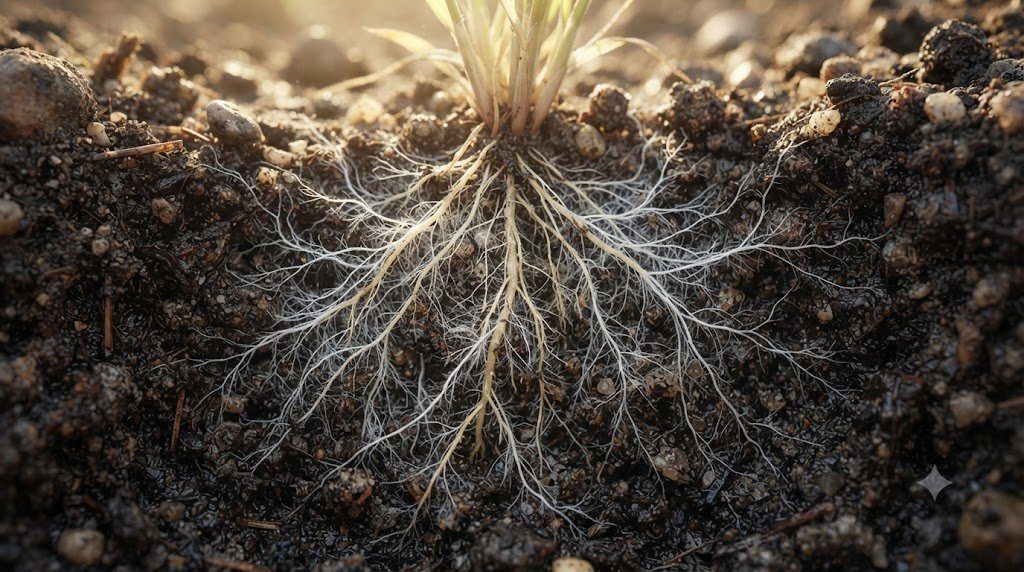
The fungus colonizes internal root cortical cells, forming highly branched intracellular nutrient-exchange structures called Arbuscules. Outside the root, the fungus extends an immense three-dimensional network of microscopic fungal threads termed Extraradical Hyphae that fan out deep into the surrounding soil matrix:
- Massive Surface Area Expansion: While plant root hairs have diameters of 10 to 20 micrometers and extend only 1 to 2 mm from the root epidermis, fungal hyphae have diameters of barely 2 to 5 micrometers. These microscopic hyphae penetrate tiny soil micropores inaccessible to thick plant roots, expanding the effective soil exploration volume by 100 to 1,000 times!
- High-Affinity Fungal Phosphate Transporters: Hyphal tips express specialized fungal phosphate transporters possessing $K_m$ affinity constants far lower than plant root transporters, scavenging orthophosphate from soil solutions containing less than 1 part per billion ($< 0.001\text{ mg P/L}$) dissolved phosphorus.
- Soil Carbon Sequestration via Glomalin: Mycorrhizal hyphae produce an extraordinary hydrophobic, iron-rich glycoprotein called Glomalin (measured as Glomalin-Related Soil Protein / GRSP). Glomalin coats soil particles like waterproof structural glue, binding individual mineral grains into water-stable macro-aggregates. Glomalin accounts for up to 15% to 20% of total soil organic carbon in undisturbed soils and persists in the soil profile for decades, shielding organic matter from microbial oxidation.
7. Agronomic Phosphorus Fertilizers: Comparative Chemistry and Rock Phosphate Processing
Modern commercial phosphorus fertilizers are manufactured by acidulating insoluble sedimentary or igneous fluoroapatite rock phosphate ($Ca_{10}(PO_4)_6F_2$) mined from global geological reserves:
| Fertilizer Name | Chemical Formula | Grade (% P2O5) | Water Solubility | Primary Agronomic Application |
|---|---|---|---|---|
| Monoammonium Phosphate (MAP) | NH4H2PO4 | 11-52-0 | 90% – 95% Soluble | Acidic fertilizer band (pH 3.5 – 4.5); ideal for calcareous and high-pH soils |
| Diammonium Phosphate (DAP) | (NH4)2HPO4 | 18-46-0 | 90% – 95% Soluble | Alkaline fertilizer band (pH 7.5 – 8.5); ideal for acidic soils; risks ammonia seedling burn |
| Triple Superphosphate (TSP) | Ca(H2PO4)2 | 0-46-0 | 85% – 90% Soluble | Zero nitrogen content; popular for legume establishment and low-N prescriptions |
| Single Superphosphate (SSP) | Ca(H2PO4)2 + CaSO4 | 0-20-0 (+12% S) | 80% – 85% Soluble | Low-analysis source; delivers valuable sulfur and calcium to deficient soils |
| Ammonium Polyphosphate (APP) | (NH4)n+2 Pn O3n+1 (Liquid) | 10-34-0 | 100% Liquid Soluble | Liquid starter fertilizer; contains 70% polyphosphate chains that chelate micro-nutrients |
| Ground Rock Phosphate | Ca10(PO4)6F2 | 0-28-0 to 0-34-0 | < 1% Water Soluble | Extremely slow release; requires strongly acidic soils (pH < 5.2) to dissolve; organic farming |
8. Placement Physics: Banding vs. Broadcast and Starter Fertilizer Synergy
Because soil phosphorus fixates aggressively upon contact with soil minerals, Application Geometry dictates fertilizer recovery efficiency:
- The Broadcast Inefficiency Trap: Broadcasting granular phosphate across the soil surface followed by tillage mixes fertilizer particles uniformly throughout the entire plow layer. This maximizes the surface area contact between phosphate granules and reactive iron, aluminum, and calcium minerals, driving maximum chemical fixation. First-year crop recovery of broadcast phosphorus rarely exceeds 10% to 20%!
- Concentrated Band Placement (Starter & Strip-Till): By concentrating fertilizer in a narrow continuous band (e.g., 5 cm beside and 5 cm below the seed furrow, termed the “2×2 placement”), the local concentration of phosphorus within the band core skyrockets to thousands of parts per million. This concentrated band chemically overwhelms and saturates the immediate soil fixation capacity. The center of the fertilizer band remains rich in soluble orthophosphate throughout the early growing season, allowing embryonic crop roots to intercept a concentrated nutrient reservoir. Concentrated banding frequently doubles phosphorus fertilizer efficiency compared to broadcast methods!
- The Ammonium-Phosphate Starter Synergy: Banding ammonium ($NH_4^+$) directly alongside orthophosphate ($H_2PO_4^-$) creates an extraordinary biochemical synergy: as crop roots absorb the ammonium cation, root cells pump hydrogen protons ($H^+$) into the rhizosphere to maintain electrochemical balance. This localized acidification dissolves calcium-phosphate precipitates in alkaline soils. Simultaneously, high ammonium stimulates root cellular synthesis of auxin hormones, causing massive lateral root branching directly within the phosphorus fertilizer band!
9. Legacy Soil Phosphorus and Agricultural Runoff Eutrophication Mechanics
Over decades of intensive agriculture in North America and Western Europe, farmers consistently applied phosphorus fertilizers at rates exceeding crop harvest removal. This multi-decade surplus accumulated a vast global reservoir of Legacy Soil Phosphorus locked in labile and non-labile soil mineral pools.
When soils become saturated with phosphorus, serious environmental liabilities emerge:
- Environmental Critical P Thresholds: In routine agronomic testing, an agronomic critical threshold of 25 to 35 ppm Mehlich-3 P achieves 95% to 100% maximum crop yield. However, when continuous heavy livestock manure applications drive soil test phosphorus levels beyond 100 to 200+ ppm, the soil sorption complex becomes chemically saturated. Any additional phosphorus applied cannot bind to soil particles and washes directly into agricultural tile drains and surface streams as dissolved reactive phosphorus (DRP).
- Aquatic Eutrophication Cascades: Unlike terrestrial environments that are often co-limited by nitrogen, freshwater lakes and rivers are almost universally Phosphorus-Limited. Introducing as little as 0.02 to 0.05 mg P/L into a freshwater body triggers massive blooms of toxic cyanobacteria (e.g., Microcystis). When the algal bloom collapses, aerobic bacterial decomposition consumes all dissolved oxygen, creating widespread hypoxia (dead zones) and catastrophic fish kills.
- Legacy Drawdown Strategies: Remediating legacy phosphorus soils requires implementing strict zero-phosphorus application policies, continuous cropping with high-removal silage crops, cover cropping with deep-rooted species, and establishing edge-of-field saturated riparian buffer strips.
10. Phosphate Rock Depletion and Future Circular Phosphorus Recycling
Unlike nitrogen, which can be synthesized indefinitely from atmospheric air via Haber-Bosch chemical reactors, phosphorus is a non-renewable, finite geological resource. Nearly 70% to 75% of the world’s remaining economic phosphate rock reserves are concentrated within a single geographical region—Morocco and Western Sahara. Geologists and agronomic economists forecast that global high-purity phosphate rock deposits will experience severe depletion within the next 100 to 250 years, giving rise to the concept of Peak Phosphorus.
To ensure long-term global food security, agricultural engineering is pioneering circular phosphorus recovery systems:
- Struvite ($MgNH_4PO_4 \cdot 6H_2O$) Precipitation: Municipal wastewater treatment facilities and dairy manure digesters are deploying fluidized bed reactors that inject magnesium chloride into anaerobic digestate liquors. This precipitates phosphorus and ammonium as pure, crystalline struvite. Struvite functions as a premium, non-burning, slow-release fertilizer with low water solubility that dissolves cleanly in response to root citric acid exudates.
- Sewage Sludge Ash Thermochemical Extraction: Incinerating municipal sewage sludge concentrates phosphorus into mineral ash (15% to 25% $P_2O_5$). Thermochemical post-treatment removes heavy metal contaminants (cadmium, lead, arsenic), producing recycled calcium phosphate fertilizers that match commercial superphosphates in agronomic trials.
- Biochar and Phosphate Sorption Composites: Engineered biochars impregnated with magnesium or calcium oxides are deployed in agricultural runoff ditches as reactive phosphorus filters, adsorbing dissolved orthophosphate before it reaches waterways. Saturated biochars are then harvested and returned to crop fields as phosphorus-enriched organic soil amendments, closing the biogeochemical nutrient loop.