🧱 Soil Morphology & Pedological Structural Mechanics
An exhaustive pedological treatise on secondary structural unit (ped) architecture. We analyze the hierarchical classification of soil peds by type, class, and grade, investigate the genetic genesis of granular epipedons, subangular blocky illuvial horizons, prismatic and columnar natric subsoils, and the compaction-induced physics of platy structures.
While soil texture dictates the static mineral particle inventory of sand, silt, and clay, Soil Structure governs the dynamic architectural arrangement of those individual particles into distinct, cohesive secondary aggregates termed Peds. If soil texture is compared to the raw bricks, gravel, and mortar delivered to a construction site, soil structure represents the completed architectural building—complete with load-bearing walls, corridors, doorways, and ventilation shafts.
A soil may possess an ideal loamy texture, yet if its structural architecture is completely destroyed—collapsing into a massive, impermeable brick or powdering into structureless single grains—the ecosystem fails. Roots cannot penetrate dense mechanical barriers, rain cannot infiltrate surface macropores, and aerobic microbes suffocate in waterlogged voids. In this comprehensive structural morphology monograph, we dissect the genetic mechanics governing pedogenesis, detail the official USDA-NRCS structural classifications, and evaluate the hydraulic consequences of aggregate geometry.
1. The Fundamental Architecture of Secondary Aggregates (Peds vs. Clods)
In field pedology, a sharp distinction is maintained between naturally formed structural units and artificially induced mechanical fractures:
- Peds (Natural Soil Structural Units): Peds are natural, persistent aggregates formed over months, years, and decades through recurring wetting-drying cycles, freeze-thaw expansion, biological root compression, fungal hyphal netting, and humic cementing. Peds are bounded by natural planes of structural weakness and often coated with distinct ped surfaces: clay skins (argillans / cutans), organic-matter coatings, or iron-manganese oxide segregations. When excavated carefully and gently tossed in the hand, a soil naturally separates along these predetermined ped boundaries.
- Clods (Artificial Mechanical Aggregates): Clods are transient, unnatural lumps produced when an agricultural implement (e.g., moldboard plow, disc harrow, or backhoe bucket) fractures a soil under artificial shear stress—frequently when the soil is worked too wet or excessively dry. Clods lack internal structural organization, possess rough, freshly torn fracture faces without clay films, and readily slake down into structureless mud upon wetting.
- Concretions and Nodules: Hard, localized mineral concentrations formed by chemical precipitation of iron, manganese, or calcium carbonate, distinct from organic-mineral peds.
| Structural Ped Type | Geometric Shape & Symmetry | Typical Soil Horizon Occurrence | Water Infiltration & Root Penetration | Pedogenic Driving Mechanism |
|---|---|---|---|---|
| Granular / Crumb | Spheroidal, rounded, porous polyhedrons (< 1 to 10 mm) | A Horizons (Topsoil, Grasslands, Forest mulch) | Rapid infiltration; optimal capillary aeration; zero root impedance | Root exudates, earthworm casts, fungal glomalin binding |
| Angular Blocky | Polyhedral blocks with sharp edges & flat rectangular faces | B Horizons (High-clay Bt subsoils) | Moderate percolation through inter-ped planar voids | Clay shrink-swell cycles; wetting and drying stress fractures |
| Subangular Blocky | Polyhedral blocks with rounded vertices & curved faces | B Horizons (Bt and Bw cambic horizons) | Good percolation; excellent root exploration along ped faces | Balanced biological activity moderating clay shear planes |
| Prismatic | Vertically elongated prisms with flat, angular caps | B Horizons (Subsoils of semi-arid and subhumid zones) | Vertical preferential flow; lateral water movement restricted | Deep vertical dessication cracking; cyclical subsoil dewatering |
| Columnar | Vertically elongated prisms with rounded, salt-bleached caps | Natric (Btn) Horizons (Sodic / Solonetzic subsoils) | Extremely slow; dispersed sodium seals inter-ped pores | High exchangeable sodium (ESP > 15%) dispersing prism tops |
| Platy | Thin, horizontal flat plates overlapping like shingles | E Horizons; surface crusts; compacted plow pans | Extremely slow infiltration; forces roots to bend horizontally | Frost heave lamination; tractor wheel compaction; wheel slip |
2. Spheroidal Architecture: Granular and Crumb Tilth in Topsoils
Granular and Crumb structures represent the pinnacle of agronomic topsoil quality, occurring almost exclusively in biological A horizons:
Morphology and Geometry: Granular peds are small (1 to 10 mm diameter), roughly spherical or polyhedral units that do not fit closely together with neighboring peds. Because the rounded surfaces touch only at discrete contact points, the intervening space forms a vast interconnected network of structural Macropores ($>75\ \mu m$). When granular peds are exceptionally porous internally, pedologists classify them as Crumb structure.
Pedogenesis: Granular peds are constructed biologically from the inside out:
- Earthworm Ingestion and Casting: An active earthworm population (e.g., Lumbricus terrestris) ingests up to 30 to 40 metric tons of soil mineral particles and organic litter per hectare annually. In the earthworm gut, calcium-secreting glands and digestive enzymes blend mineral clay platelets with decomposing organic biopolymers. The excreted earthworm casts form water-stable granular peds that resist raindrop disintegration for multiple seasons.
- Mycorrhizal Glomalin Netting: Arbuscular mycorrhizal fungi (AMF) produce an insoluble hydrophobic glycoprotein known as Glomalin. Fungal hyphae physically wrap around clusters of silt and sand grains like an architectural nylon mesh, while sticky glomalin ‘glues’ the particles into water-stable crumbs.
- Fibrous Root Cleavage: Fine grass roots exert continuous lateral hydraulic pressure, repeatedly compressing surrounding micro-aggregates while releasing organic mucilage and polysaccharides that stabilize granular peds.
🔍 Field Structural Evaluation: Grading Ped Distinctness
Under USDA-NRCS soil survey protocols, soil structure is evaluated across three parameters: Type (Shape), Class (Size), and Grade (Distinctness). Grade describes the durability and distinctness of aggregation when moist soil is handled: (0) Structureless: Zero observable aggregation (massive or single grain); (1) Weak: Barely observable peds; handling crushes material into unaggregated grains; (2) Moderate: Well-formed, distinct peds that are moderately durable; (3) Strong: Rigid, durable peds that remain intact when removed from the pit face and resist gentle crushing.
3. Blocky Architecture: Angular vs. Subangular Structural Mechanics
As percolating rainfall leaches downward into subsoil B horizons, biological root activity diminishes while clay accumulation increases, transforming spheroidal granules into Blocky Structures:
1. Subangular Blocky (SAB): Characterized by three-dimensional blocks (5 to 50 mm) whose edges and vertices are rounded. Because the corners are smoothed, SAB structures allow continuous tortuous pore spaces between peds. Plant roots navigate around subangular blocks with ease, exploring ped surfaces coated with nutrients. Subangular blocky structure is typical of fertile, well-drained Bw (cambic) and upper Bt (argillic) horizons in productive agricultural soils.
2. Angular Blocky (AB): Characterized by sharp, razor-defined edges and flat, planar faces that interlock tightly with adjacent peds like a 3D jigsaw puzzle. Formed in dense subsoils containing high concentrations of 2:1 expanding clays under severe wetting and drying stress. When dry, inter-ped planar cracks open, allowing rapid preferential water drainage; however, upon wetting, the clay blocks swell, pressing against one another and completely closing the planar cracks. In heavy angular blocky subsoils, internal aeration becomes temporarily restricted until plant roots extract water to re-open fracture planes.
4. Vertically Oriented Soils: Prismatic vs. Columnar Structures
In semi-arid and arid landscapes, cyclical moisture deficits produce vertically oriented structural architecture:
- Prismatic Structure: Structural units are vertically elongated columns (10 to 100 mm wide, often extending 20 to 50 cm vertically) with flat, horizontal caps. Prisms develop in subsoils subjected to severe seasonal moisture depletion. As water is pulled upward by evapotranspiration, deep vertical tension cracks propagate downward through the profile. Percolating rainfall washes fine clay and organic colloids down these vertical fissures, forming dark vertical clay coatings (cutans) that permanently stabilize the prism walls. Water movement is strongly anisotropic—rapid vertical gravitational flow along prism faces, but near-zero lateral movement through prism interiors.
- Columnar Structure (The Sodic Hallmark): Columnar units are vertically elongated prisms featuring distinct rounded, dome-shaped caps heavily coated with bleached, white silt and quartz sand. Columnar structure is the universal diagnostic indicator of a Natric (Btn) Subsoil Horizon in sodic soils (Solonetz). High exchangeable sodium (ESP > 15%) disperses clay platelets at the top of each prism. The dispersed clay washes downward into the prism body, leaving behind a bleached dome of resistant silica while sealing the internal pores. Columnar subsoils present an almost impenetrable barrier to root penetration and water infiltration.
5. Horizontally Compressed Peds: Platy Structure and Compaction Genesis
Unlike spheroidal, blocky, or prismatic units, Platy Structure is oriented horizontally, with structural units resembling thin, flat plates or wafers stacked one atop another:
- Natural Genetic Platy Structure: Occurs naturally in leached, acidic albic E Horizons of Spodosols and Alfisols, where freeze-thaw lens formation (cryogenic lamination) or horizontal groundwater lateral flow aligns mineral platelets horizontally over centuries.
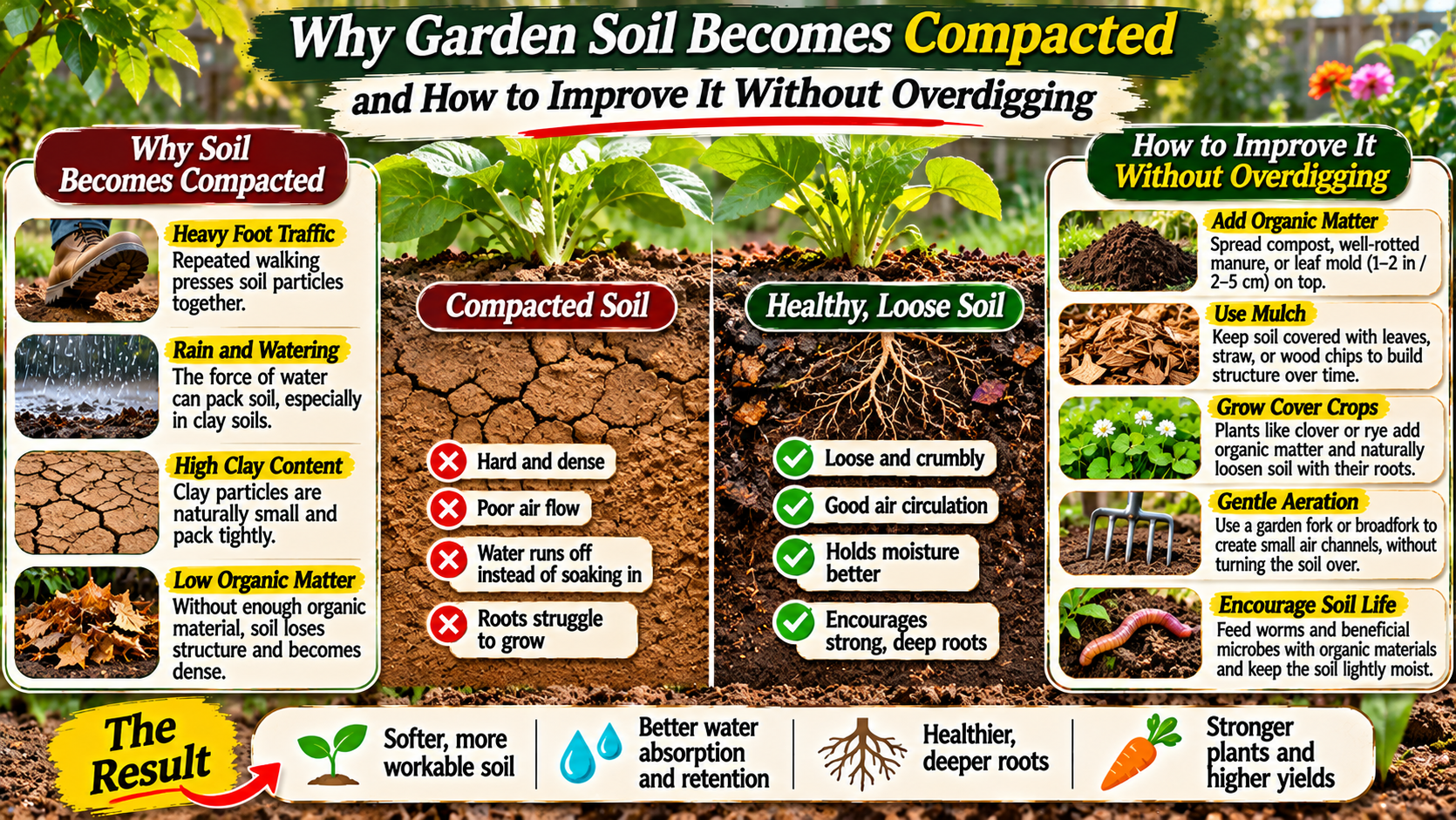
- Anthropogenic Compaction Platy Structure (The Plow Pan): Occurs directly beneath the tillage depth (typically 15 to 25 cm depth) in cultivated agricultural fields. When heavy tractors, combines, and moldboard plows operate on moist soils, horizontal wheel slip and vertical axle loads exert tremendous mechanical shear stress. The rotating wheels smear subsoil clay particles, crushing rounded granular peds and flattening them into dense, overlapping horizontal plates.
- Hydraulic and Agronomic Consequences of Platy Compaction: Because gravity pulls water vertically, water encounters thousands of overlapping horizontal plate faces, drastically reducing saturated hydraulic conductivity from 25 mm/hr down to less than 1.0 mm/hr! Water perches above the platy layer, creating an artificial water table that drowns roots. Simultaneously, descending crop taproots hit the impenetrable platy boundary and are forced to grow horizontally (the ‘L-shaped root’ or ‘J-root’ deformity), severely restricting access to subsoil moisture and nutrients during summer droughts.
6. Structureless Soil Conditions: Single Grain vs. Massive Profiles
Under USDA Soil Taxonomy, soils lacking observable aggregation into peds are designated as Structureless, falling into two extreme mechanical categories:
- Single Grain (Structureless Coarse): Individual mineral particles show zero cohesion or adhesion to one another. Typical of coarse dune sands, beach sands, and young sandy Entisols. When excavated, single grain soil flows freely through the fingers like dry hourglass sand. While macroporosity is vast (enabling rapid infiltration), water holding capacity is virtually non-existent, and the profile is exceptionally vulnerable to catastrophic wind erosion.
- Massive (Structureless Dense): The entire soil horizon is cemented or fused into a solid, continuous mineral block lacking any natural planes of structural cleavage. Occurs in heavy clay subsoils, cementation hardpans (duripans, fragipans), or in cultivated fields where intensive rototilling on wet soil has pulverized all natural peds into an amorphous slurry that dries into concrete-like blocks. In a massive horizon, roots are restricted exclusively to old biological worm channels or structural cracks.
7. Quantitative Laboratory and In-Field Aggregate Stability Testing
Evaluating how well peds resist physical disintegration when exposed to rainfall or tillage is the definitive test of structural health:
The Wet Sieving Aggregate Stability Test (Kemper & Rosenau Method):
- A known mass (typically 4.0 g) of air-dried soil aggregates (1 to 2 mm diameter) is placed on a 0.25 mm wire-mesh sieve immersed in a water container.
- The sieve is mechanically oscillated vertically through the water column at a stroke rate of 35 cycles per minute for 10 minutes.
- Aggregates with weak internal bonding slake rapidly, disintegrating into individual sand, silt, and clay particles that wash through the sieve. Highly stable aggregates bonded by glomalin, humic acids, and divalent calcium remain intact on the screen.
- The percentage of Water-Stable Aggregates (WSA%) is calculated after correcting for coarse sand fragments:
ext{WSA\%} = rac{ ext{Mass of stable aggregates remaining}}{ ext{Total initial aggregate mass} – ext{Sand mass}} imes 100\%
Healthy virgin grassland Mollisols exhibit WSA > 85%, whereas conventionally tilled fields subjected to decades of moldboard plowing frequently drop below 20% to 30%, indicating critical structural collapse.
8. Structural Regeneration: Cover Crops, Calcium, and Reduced Tillage
Restoring degraded blocky or platy soils into vibrant, friable granular tilth requires integrating physical, chemical, and biological interventions:
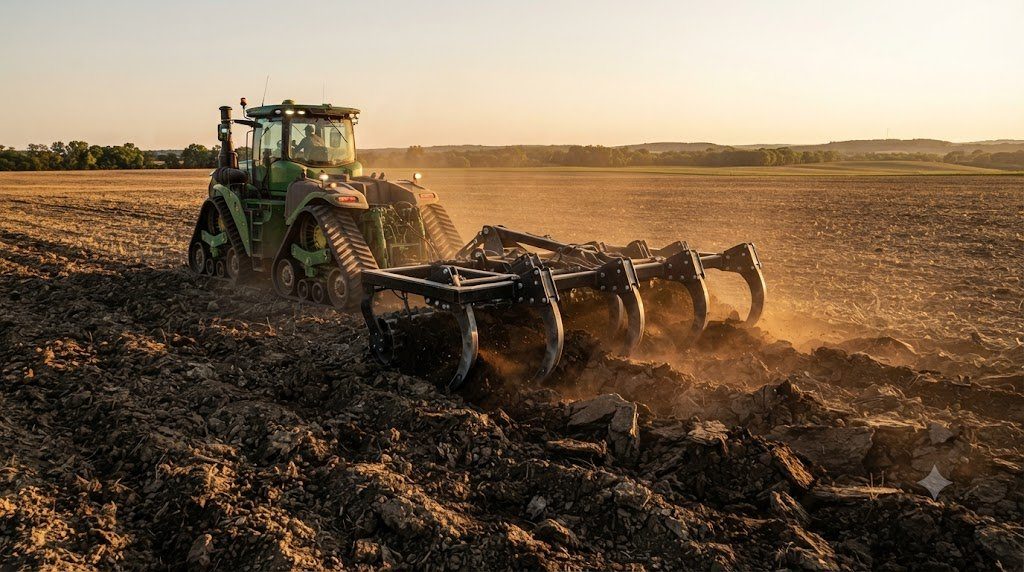
- Mechanical Deep Shattering (Inline Ripping / Subsoiling): Utilizing narrow, parabolic subsoiler shanks operating 5 cm beneath the compacted platy pan under dry soil conditions fractures the horizontal hardpan into irregular blocks without inverting subsoil clay to the surface.
- Chemical Flocculation via Soluble Calcium (Gypsum / Lime): In soils degraded by sodium dispersion or high magnesium:calcium ratios, applying 2 to 5 metric tons of agricultural gypsum ($CaSO_4 \cdot 2H_2O$) floods the exchange complex with divalent $Ca^{2+}$. Calcium compresses the diffuse double layer, inducing immediate flocculation of dispersed clay platelets into embryonic micro-aggregates.
- Biological Architecture via Continuous Root exudates: Planting a biodiverse cover crop blend (cereal rye, hairy vetch, crimson clover, tillage radish) feeds the soil biome. The constant production of fungal glomalin, bacterial polysaccharides, and root mucilage binds the flocculated particles into durable, water-stable granular peds that sustain productive agriculture.
9. Ped Surface Coatings: Cutans, Slickensides, and Redoximorphic Features
In addition to aggregate geometry, pedologists evaluate Ped Surface Coatings and Stress Features to reconstruct the pedogenic history of the soil horizon:
- Argillans (Clay Skins / Cutans): Thin, translucent, oriented coatings of illuvial phyllosilicate clay platelets deposited on ped faces and lining pore channels in Bt horizons. As percolating soil water evaporates or is extracted by roots, suspended colloidal clay platelets orient parallel to ped surfaces. Under a 10x hand lens or petrographic microscope, argillans exhibit a distinct waxy, lustrous sheen. The presence of continuous clay films covering more than 50% of ped faces is the primary diagnostic criterion for an illuvial Argillic Horizon.
- Slickensides (Stress Cutans): Polished, grooved, mirror-like shear planes formed in heavy 2:1 smectite clay soils (Vertisols). When expanding clay blocks swell against each other under severe hydrostatic pressure, opposing ped surfaces slide past one another under friction, polishing the mineral faces and creating parallel striations.
- Redoximorphic Concentrations and Depletions: In seasonally waterlogged soils, periods of anaerobic saturation cause microbes to reduce insoluble ferric iron ($Fe^{3+}$) to soluble ferrous iron ($Fe^{2+}$). The dissolved iron is stripped from ped surfaces (forming grayish, bleached redox depletions). When the profile dries and aerates, iron oxidizes into brilliant reddish-orange rust mottles (redox concentrations) on ped interiors. Mapping the distribution of these coatings allows soil scientists to determine seasonal high water table depths with millimeter precision!